Main types of pressure gauges and their applications
Leave a message
A pressure gauge is an important instrument used to measure the internal pressure of a gas or liquid. It provides quantitative readings by sensing pressure changes in the medium, thereby helping operators determine whether the equipment is operating safely. Due to the different media types, working pressure ranges, and media corrosiveness in actual applications, pressure gauges are designed into various types to meet the needs of different measurement scenarios. Below, we will conduct an in-depth analysis of the six mainstream pressure gauge types and discuss their working mechanisms in actual work.
Spring tube pressure gauge
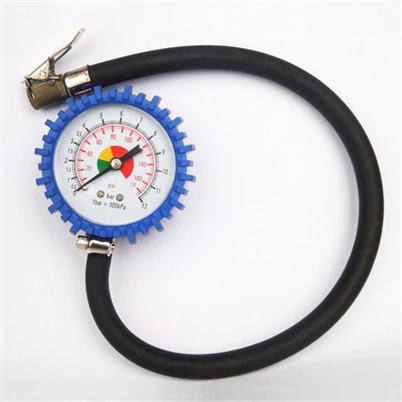
Spring tube pressure gauge is a pressure gauge based on the mechanical measurement principle. Its core component is a C-shaped or spiral metal Bourdon tube. When the internal medium generates pressure, a difference is formed between the pressure inside the tube and the external atmospheric pressure, causing slight deformation of the Bourdon tube. This deformation is transmitted through a lever mechanism to the pointer, which rotates and displays the pressure reading on the dial. Because the meter does not rely on power supply and electronic components, it is widely used in traditional industrial equipment such as boilers, gas cylinders, water pumps, and compressors. Although its measurement accuracy and response speed are limited and it is not suitable for high-frequency dynamic measurements, for most routine monitoring that does not require data recording, this type of pressure gauge is extremely cost-effective due to its low cost and simple maintenance.

Digital Pressure Gauge
Digital pressure gauges use electronic pressure sensors as the measurement core. When working, it will first convert the medium pressure into an electrical signal, then process the signal through the analog-to-digital conversion module and display it in digital form on the LCD screen. This pressure gauge completely eliminates the reading errors caused by different pointer angles or vibration interference in traditional mechanical gauges, greatly improving the reading accuracy. More importantly, digital pressure gauges can integrate multiple functions, such as pressure trend recording, maximum value storage, remote data output, and alarm settings. They are especially suitable for pharmaceuticals, biological experiments, food production, semiconductor processing, and other environments that require extremely high data accuracy.
Differential pressure gauge
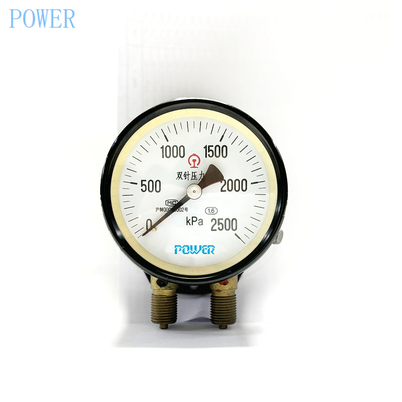
The differential pressure gauge does not measure the absolute pressure at a point, but is connected to two measurement ports at the same time and measures the pressure difference between the two through the internal structure. This design is ideal for monitoring changes in system resistance or fluid flow performance. For example, differential pressure gauges are connected to the front and rear ends of the filtering equipment. If the pressure difference between the front and rear continues to increase, it means that the filter element is beginning to become clogged and needs to be cleaned or replaced in time to avoid a decrease in system efficiency or safety hazards caused by excessive pressure. In addition, in liquid level control, the differential pressure gauge can also determine the liquid level by detecting the pressure difference between the upper and lower liquid columns of the container. A liquid level that is too high may cause liquid to overflow, causing equipment damage or even safety accidents; while a liquid level that is too low may cause the pump to run dry, the heater to dry out, or the reactor to interrupt the reaction. Accurately judging the liquid level through the differential pressure gauge can realize real-time monitoring of the liquid level and ensure the safe operation of the equipment.
Vacuum pressure gauge
Vacuum pressure gauge is a pressure gauge designed specifically for measuring "negative pressure" environments that are lower than standard atmospheric pressure. Its working principle is similar to that of a positive pressure gauge, which also uses a Bourdon tube or capacitive sensing element to sense pressure, but its scale range covers the negative pressure range. It is often used in vacuum packaging, vacuum drying, air extraction systems, chemical reactors and other equipment to determine whether the vacuum degree inside the system meets the standard. Since the pressure in a vacuum environment is small and easily affected by temperature, air tightness, etc., vacuum pressure gauges usually have higher sensitivity and stronger sealing performance. If an ordinary pressure gauge is used in a negative pressure system, it will not only cause data distortion, but may also cause damage to the instrument due to structural mismatch.

Electric contact pressure gauge
The electric contact pressure gauge is an instrument with an electric contact structure added to the conventional pressure gauge. When the actual pressure value reaches the upper or lower limit set by the user, the built-in contact will trigger the closing or opening of the circuit, thereby starting the alarm, controlling the valve or linking other automatic control equipment. This device is very suitable for scenarios that require real-time response to pressure and take measures, such as boiler overpressure exhaust, hydraulic system oil pump start and stop, power plant turbine auxiliary protection, etc. The emergence of electric contact pressure gauges has greatly improved the safety factor and management efficiency of industrial equipment, and is especially suitable for unattended production environments or where real-time response is required.
Diaphragm Pressure Gauge
Diaphragm pressure gauges have a diaphragm between the measured medium (such as acid, alkali, mud, etc.) and the mechanical or electronic components inside the measurement system. This diaphragm is usually made of corrosion-resistant materials such as stainless steel, tantalum, Hastelloy, and fluoroplastics. It is not corroded by highly corrosive media and has a certain degree of flexibility.
When the medium exerts pressure on the diaphragm, the surface of the diaphragm undergoes slight elastic deformation (ie, bulges inward or outward). This deformation amplitude is very small, but it is enough to drive the filling liquid behind it (such as silicone oil, glycerin, etc.) to produce the same pressure change. Since the liquid is incompressible, the pressure can be transmitted to the back-end measuring elements, such as Bourdon tubes, strain gauges or pressure sensors, without loss and equivalently, so that the pressure value can be accurately measured.