

Your Professional Liquid Filled Gauge Supplier
Suzhou Power Meter Co., Ltd. is a professional supplier of pressure and temperature instrument devices. We specialize in the design and manufacturing of various types of pressure gauges and temperature gauges, customized according to customer specifications.


Why choose us
Our Certificates
Our pressure gauges and temperature gauges are certified with ISO9001, CE, and KS standards.
Sales Market
Our products are sold worldwide. Approximately 40% are exported to Europe, 30% to Southeast Asia, 15% to North America, and 5% each to South America, Africa, and the Middle East.
Our Service
We have a professional technical team that provides solutions for pressure and temperature measurement. We recommend suitable pressure and temperature instruments based on your needs. Our sales team will offer you competitive prices along with detailed product specifications before cooperation.
Liquid Filled Gauge
Liquid filled gauges are used for measuring pressure points of high stress like fast and frequent loads, pressure peaks and mechanical vibrations. Liquid filled gauges are typically filled with either glycerine only or a combination of glycerine and water. Specific glycerine gauges are needed depending on the different conditions you require the gauge for.
Technical Parameters
|
Product name |
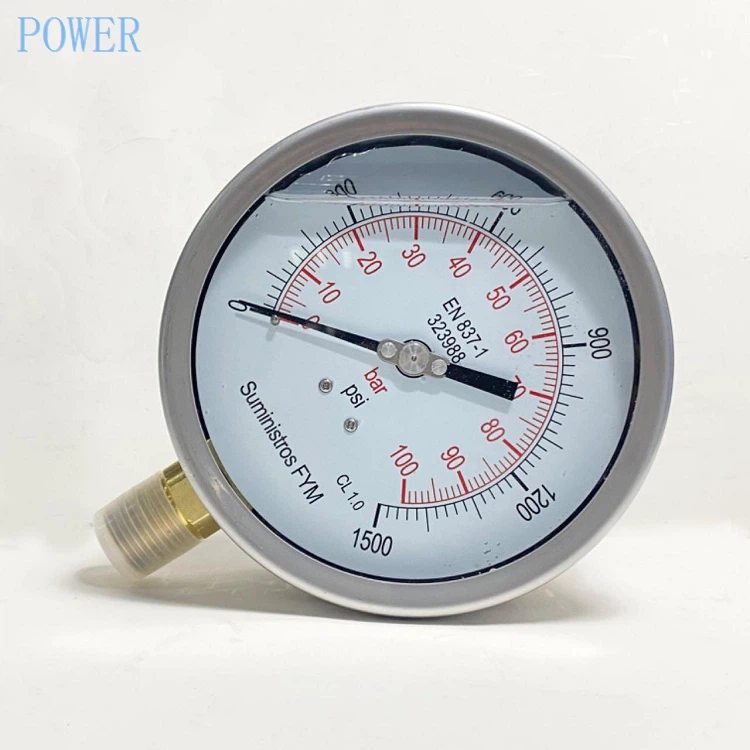
4.5inch-125mm bottom connection liquid filled type pressure gauge |
|
Model number |
YTN-125A |
|
Diameter size |
(1.5")40mm; 2"(50mm); 2.5"(63mm); 3.5"(75mm); 4"(100mm); 4.5"(125mm);6"(150mm); 8"(200mm); 10"(250mm) etc. |
|
Case/cover |
Stainless steel case |
|
Window |
Tempered glass |
|
Connection |
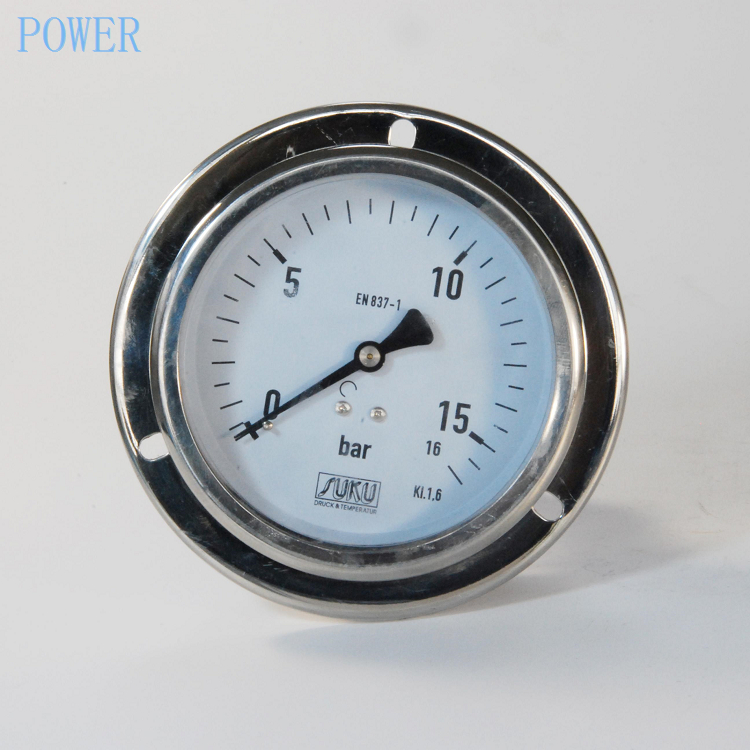
Brass Bottom (back/back with clamp or flange etc.) |
|
Thread |
G/PT/NPT 1/8;1/4;1/2;M14x1.5;M20x1.5 ,ect |
|
Bourdon tube |
Phosphor bronze |
|
Movement |
Brass |
|
Dial plate |
Aluminum |
|
Pressure range |
-0.1~100mpa |
|
Accuracy |
1.0% |
|
Liquid filling |
Yes |
|
Liquid |
Dry;Glycerin ; silicon oil |
Benefits of Liquid Filled Gauge
Durability
Liquid-filled gauges are more durable than dry gauges. Because the internal fluid dampens system pulsation, the gauge can better stand up to shock and vibration during transport and in your system. This also means they have greater moisture resistance, reducing the potential for condensation and icing.

No Pressure Vent
Our Flex Window gauge does not have a pressure vent. This means glycerin cannot leak from the gauge during normal function, unlike some other liquid-filled gauges. The flexible window acts as the pressure compensation element for the gauge, which allows it to be 100% hermetically sealed, ideal for use in any orientation.
Clarity
Because the gauge is completely filled with liquid, there is no visible bubble to inhibit gauge readings. On our liquid-filled pressure gauge, the transparent rubber face is also highly resistant to UV light, bacteria, ozone, and radiation, and the curved lens surface acts as a magnifying feature that also repels water droplets.
Types of liquid
Liquid filled pressure gauges use different types of liquid:
Glycerin
Glycerin is the most common liquid in a liquid-filled pressure gauge because of the price and vibration dampening at room temperature. These gauges work well between -20 °C and 60 °C (-4 - 140 °F) .
Silicone
Silicone-filled pressure gauges are applicable for higher temperature ranges. They operate between -40 °C to 140 °C (-40 - 284 °F) .
Halocarbon
Halocarbon-filled pressure gauges are suitable for systems with oxidizing agents such as oxygen, hydrogen peroxide, and chlorine. They work well at the same temperatures as glycerin filled gauges.

Applications
Standard liquid filled gauges are filled with 100% (99.7% min.) glycerine which starts to become viscous at +17 degrees C, as the temperature decreases the more slimy the glycerine becomes causing the pointer to move slowly to the correct position. At -5 degrees C the gauge would stop operating completely. Locations with an even temperature that doesn't fluctuate often, would be the perfect home for a standard gauge.
Liquid filled gauges that have 2 parts glycerine with 1 part water can be used in temperatures as low as -46 degrees C. These types of gauges are ideal for locations that have extremely cold circumstances. For example, regions that have harsher winter temperatures may consider this type of gauge.
The general selection criteria for fluid filled pressure gauges are mainly identical to dry pressure gauges. However, there are some additional considerations when choosing a liquid filled gauge.
Type of liquid filling: Glycerin is suitable for vibration protection at room temperature, while silicone oil is common for high-temperature and extreme temperature fluctuation applications. Halocarbon, finally, is suitable for gauges connected to applications with oxidizing agents.
Necessity versus cost: While fluid filled gauges offer clear advantages over dry pressure gauges, they are often more expensive for the same measurement range. The reduced wear on liquid-filled gauges will offer a cost advantage for long-term use. A liquid-filled gauge is unnecessary if the application doesn't have vibrations, pulsations, condensation concerns, or extreme temperatures. Consider a dry gauge instead.
Packaging&Transportation

Company Honor


FAQ
We're professional liquid filled gauge manufacturers and suppliers in China, specialized in providing high quality customized service. We warmly welcome you to wholesale discount liquid filled gauge made in China here from our factory. For price consultation, contact us.
Panel Mount Glycerin Filled Pressure Gauge With Flange, Back Connection Glycerin Filled Pressure Gauge, liquid filled gauge