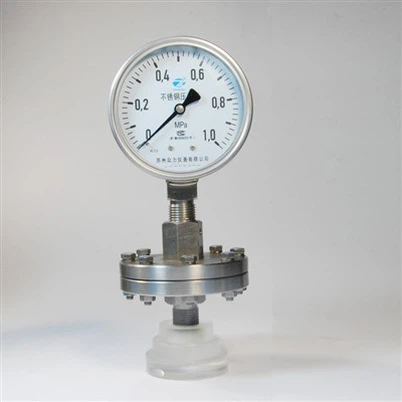
How do pressure gauges work in fluid systems?
Leave a message
In fluid systems, pressure is one of the core parameters that determines the operating status of the system, but it is neither visible nor judged by the naked eye. Therefore, the function of the pressure gauge is to convert this "invisible" physical quantity into a "readable" value, providing an intuitive reference point to help operators grasp the system status in real time. Through the pressure gauge, staff can detect abnormal fluctuations in time and take adjustment or protective measures to prevent equipment damage or safety accidents. This article will give you an in-depth understanding of the core role, working principle and usage details of pressure gauges in fluid systems, revealing the key role they play in ensuring the safe operation of fluid systems.

In a closed fluid system, whether liquid or gas, pressure will fluctuate due to factors such as temperature changes, valve opening, pump speed adjustments, or resistance changes. If this fluctuation is not monitored, it can easily cause the system to go out of control. For example, too high pressure may cause pipes or containers to rupture, leak or even explode; while too low pressure may mean that pumps are idling, fluids are backflowing, or the system is unable to properly promote the flow of media.
How A Pressure Gauge Works
Most traditional pressure gauges are of mechanical construction, the most common being the Bourdon tube pressure gauge. Its core component is a curved metal pipe (Bourdon tube). When system pressure acts on the pipe, the pipe will undergo slight bending or stretching deformation due to the pressure difference between the inside and outside. This mechanical deformation is amplified through a mechanism of levers, gears and linkages and transmitted to the pointer, causing it to indicate the current pressure value on the dial. The entire working process does not rely on power supply, so it has stable response and strong anti-interference.
Another common type is the electronic pressure gauge, which uses a piezoresistive sensor or strain gauge internally to sense pressure changes. When pressure acts on a sensing element, it causes a change in its resistance or voltage. After this change is processed by the circuit, it is converted into a digital signal and displayed on the LCD screen. The advantages of electronic pressure gauges are fast response, high accuracy, and they can be connected to data acquisition systems for remote monitoring and automatic control.
Even if a suitable pressure gauge is selected, improper installation will seriously affect its reading accuracy and service life. First of all, the pressure gauge should be installed in a location with stable medium flow, away from the pump port, elbow or throttle valve, to reduce the interference of local pressure fluctuations on the reading. Secondly, the pressure gauge should be installed vertically to facilitate observation and avoid errors; if the pressure gauge is used in a steam or high-temperature gas system, a condenser tube or isolator needs to be installed to prevent high temperature from directly acting on the gauge head and damaging the internal mechanism. Furthermore, users should avoid tilting the dial downwards or outwards at too large an angle. This will not only affect visual reading, but may also cause the internal mechanism to be deformed by gravity for a long time.

Typical Symptoms And Countermeasures Of Pressure Gauge Failure
Pressure gauge failure usually manifests itself as pointer failure to return to zero, abnormally high or low readings, violent pointer jumps, slow response or even no indication. Common causes of these problems include: excessive pressure shock causing permanent deformation of the Bourdon tube, medium corrosion causing sensing component failure, seal damage causing internal leakage, vibration shock causing the connecting rod mechanism to loosen, etc.
When facing the failure of a pressure gauge, users should first determine whether the structure is damaged due to overpressure, overtemperature or external impact, and after confirmation, promptly replace the gauge with a new one of the same model and range. For highly corrosive or high-viscosity media, users need to equip the pressure gauge with a chemical diaphragm to prevent the media from directly contacting internal components. In addition, installing a safety valve, anti-vibration pad or throttle can also prevent damage to the pressure gauge to a certain extent.