What is the difference in using a safety pattern pressure gauge for gas and liquid?
Leave a message

Hey there! As a supplier of safety pattern pressure gauges, I often get asked about the differences in using these gauges for gas and liquid. Well, let's dive right into it and explore what sets them apart.
First off, let's talk about the basic function of a safety pattern pressure gauge. It's designed to measure the pressure of a fluid, whether it's a gas or a liquid. But the way it interacts with these two types of fluids can be quite different.
Construction and Design
One of the key differences lies in the construction and design of the gauge. When it comes to gas applications, the gauge needs to be able to handle the unique properties of gases. Gases are compressible, which means they can change volume significantly under pressure. So, a safety pattern pressure gauge for gas is typically designed with a more sensitive mechanism to accurately measure these pressure changes.
On the other hand, liquids are generally considered incompressible. This means that the pressure changes in a liquid are more straightforward and less extreme compared to gases. As a result, a pressure gauge for liquid can have a slightly less sensitive mechanism.
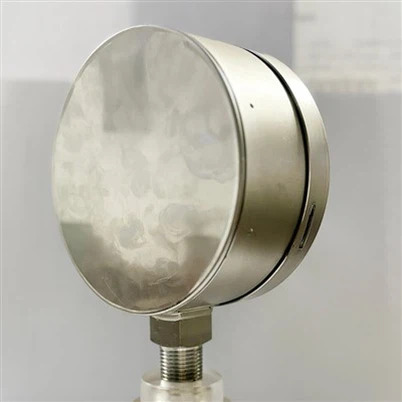
For example, our Safety Patten Dial 160mm Solid Front Pressure Gauge is a great option for both gas and liquid applications. But for gas, its precision mechanism really shines in accurately capturing those subtle pressure variations.
Diaphragm and Bourdon Tube
The diaphragm and Bourdon tube are two common components in a pressure gauge. In gas applications, the diaphragm or Bourdon tube needs to be more flexible to respond to the compressibility of the gas. A thinner and more elastic material is often used to ensure accurate readings.
For liquid applications, the diaphragm or Bourdon tube can be made of a slightly thicker and more rigid material. Since liquids don't compress as much, the gauge doesn't need to be as sensitive to small pressure changes.
Our Safety Patten Dial 100mm Solid Front Pressure Gauge features a well - designed Bourdon tube that can be adjusted to suit either gas or liquid use. For gas, we can fine - tune the tube to be more responsive, while for liquid, it can be set to handle the more stable pressure environment.
Corrosion and Contamination
Another important factor is corrosion and contamination. Gases can sometimes contain corrosive elements or contaminants that can damage the pressure gauge. So, for gas applications, the gauge needs to be made of materials that are resistant to corrosion. Stainless steel is a popular choice as it can withstand the harsh conditions often associated with gas environments.
Liquids can also be corrosive, but the type of corrosion and the rate at which it occurs can be different. Some liquids may have a more acidic or alkaline nature. In such cases, the gauge needs to be protected accordingly. For example, our Phenolic Case Pressure Gauge has a phenolic case that provides good protection against both gas and liquid - related corrosion.
Mounting and Installation
The mounting and installation of the pressure gauge can also vary depending on whether it's for gas or liquid. Gas systems often have lower pressures and may require a more delicate installation to avoid any leaks. The gauge needs to be properly sealed to prevent the gas from escaping.
Liquid systems, especially those with high pressures, may require a more robust mounting. The gauge needs to be firmly attached to withstand the force exerted by the liquid.
Accuracy and Calibration
Accuracy is crucial in both gas and liquid applications, but the calibration requirements can be different. Gas pressure measurements are often more critical in industries where even a small pressure variation can have a significant impact, such as in the chemical or pharmaceutical industries. So, gas pressure gauges need to be calibrated more frequently to ensure accurate readings.
Liquid pressure gauges also need to be calibrated, but the intervals may be less frequent, especially in less critical applications. However, in industries like hydraulic systems, high accuracy is still essential, and regular calibration is a must.


Maintenance
Maintenance of the pressure gauge is another area where the differences between gas and liquid use become apparent. Gas gauges may need more frequent checks for leaks, as even a small leak can affect the pressure reading and pose a safety hazard.
Liquid gauges need to be checked for clogging, especially if the liquid contains particles or debris. Flushing the gauge regularly can help prevent clogging and ensure accurate measurements.
In conclusion, while the basic function of a safety pattern pressure gauge remains the same for both gas and liquid, there are several key differences in construction, design, mounting, calibration, and maintenance. As a supplier, we understand these differences and can provide you with the right pressure gauge for your specific application.
If you're in the market for a safety pattern pressure gauge, whether it's for gas or liquid, feel free to reach out. We're here to help you find the perfect solution for your needs. Let's have a chat about your requirements and see how we can assist you in getting the most accurate and reliable pressure gauge for your system.
References
- "Pressure Gauge Handbook" - A comprehensive guide on pressure gauge technology and applications.
- Industry standards and regulations related to pressure measurement in gas and liquid systems.