What are the signal outputs of a safety pattern pressure gauge?
Leave a message

Hey there! As a safety pattern pressure gauge supplier, I often get asked about the signal outputs of these nifty devices. So, I thought I'd take a deep dive into this topic and share everything you need to know.
First off, let's understand what a safety pattern pressure gauge is. It's a specialized pressure - measuring instrument designed with safety features to prevent potential hazards in industrial settings. These gauges are used in a wide range of applications, from chemical plants to oil refineries, where accurate pressure measurement is crucial for safe and efficient operation.
Now, onto the main question: what are the signal outputs of a safety pattern pressure gauge?
Analog Output
The most common signal output in safety pattern pressure gauges is the analog output. These gauges typically have a dial with a pointer that moves across a calibrated scale to indicate the pressure. It's a simple and straightforward way to get a visual reading of the pressure.
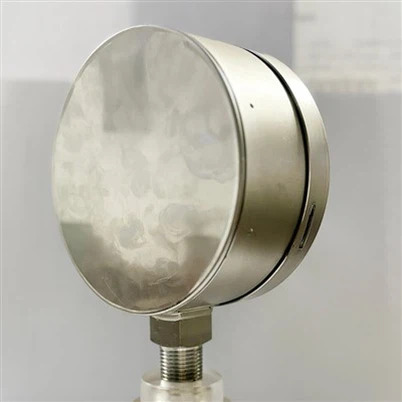
For instance, our Safety Patten Dial 125mm Solid Front Pressure Gauge features a large, easy - to - read dial. The analog output is great because it allows operators to quickly assess the pressure at a glance. You don't need any fancy equipment or software to interpret the reading. It's just a matter of looking at where the pointer is on the scale.
However, analog outputs do have some limitations. They are not suitable for remote monitoring or for use in automated control systems. Also, the accuracy of the reading can be affected by the operator's eyesight and how well they can read the scale.
Digital Output
In recent years, digital output has become increasingly popular in safety pattern pressure gauges. Digital gauges use sensors to convert the pressure into an electrical signal, which is then processed and displayed as a numerical value on a digital screen.
Our Phenolic Case Pressure Gauge offers a digital output option. Digital outputs have several advantages over analog ones. They provide more precise and accurate readings, and they can be easily integrated into automated control systems. You can connect a digital pressure gauge to a computer or a PLC (Programmable Logic Controller) and use software to monitor and record the pressure data over time.
Another benefit of digital outputs is that they are suitable for remote monitoring. You can access the pressure readings from anywhere using a network connection, which is incredibly useful in large industrial facilities where it's not always practical to have an operator constantly checking the gauges on - site.
4 - 20mA Output
The 4 - 20mA output is a standard analog signal used in industrial process control. In a safety pattern pressure gauge with a 4 - 20mA output, the current signal is proportional to the pressure being measured. A current of 4mA typically represents the minimum pressure in the measurement range, while 20mA represents the maximum pressure.
This type of output is widely used because it is relatively simple to transmit over long distances and is resistant to electromagnetic interference. It can be easily connected to other industrial devices such as transmitters, recorders, and controllers. For example, if you're using a safety pattern pressure gauge in a chemical process, the 4 - 20mA output can be used to control the flow of chemicals based on the pressure readings.
Voltage Output
Some safety pattern pressure gauges also offer a voltage output. The most common voltage ranges are 0 - 5V or 0 - 10V. Similar to the 4 - 20mA output, the voltage is proportional to the pressure.
Voltage outputs are often used in applications where the measurement system is more sensitive and requires a more precise signal. However, they are more susceptible to interference compared to 4 - 20mA outputs, especially over long distances.
Pulse Output
Pulse output is another type of signal output found in some safety pattern pressure gauges. With a pulse output, the gauge generates a series of electrical pulses. The frequency of the pulses is proportional to the pressure.
This type of output is useful in applications where you need to measure the rate of change of pressure. For example, in a hydraulic system, the pulse output can be used to detect sudden changes in pressure, which could indicate a problem such as a leak or a blocked valve.
Wireless Output
In today's connected world, wireless output is becoming an increasingly attractive option for safety pattern pressure gauges. Wireless gauges use technologies such as Bluetooth, Wi - Fi, or ZigBee to transmit the pressure data to a receiver.
Our Safety Patten Dial 63mm Solid Front Pressure Gauge can be equipped with a wireless output option. Wireless outputs offer the ultimate flexibility in terms of installation and monitoring. You don't need to run cables between the gauge and the monitoring system, which can save a lot of time and money in large industrial installations.
However, wireless outputs do require a reliable network infrastructure, and there may be security concerns when transmitting sensitive pressure data over the air.


So, when choosing a safety pattern pressure gauge for your application, it's important to consider which signal output is the most suitable. You need to think about factors such as the accuracy required, whether you need remote monitoring capabilities, and how the gauge will integrate with your existing control systems.
If you're in the market for a high - quality safety pattern pressure gauge, I'd love to chat with you. Whether you need an analog gauge for a simple visual inspection or a digital gauge with advanced wireless capabilities, we've got a wide range of products to meet your needs. Reach out to us to start a procurement discussion and find the perfect pressure gauge for your specific application.
References
- Instrumentation Handbooks: Various editions covering pressure measurement and control.
- Industry whitepapers on safety pattern pressure gauges and their applications.