Why Is Venting Important in Liquid-Filled Pressure Gauges?
Leave a message

In the field of industrial measurement and control, pressure gauges are an important tool for monitoring the operating status of the system. Among them, liquid-filled pressure gauges (also called hydraulic gauges) are widely used due to their good seismic performance and advantages in preventing water vapor condensation and medium corrosion. However, in order for this type of instrument to maintain measurement accuracy in actual operation, "exhaust" is an essential operation step. Improper venting often results in zero offset, abnormal readings, or even fogging of the dial. Therefore, this article will focus on the exhaust issue of liquid-filled pressure gauges, analyze the possible effects of not exhausting, and explain under what circumstances and in what way the correct exhaust operation is most reasonable.
When a liquid-filled pressure gauge leaves the factory, a certain amount of damping liquid, such as glycerin or silicone oil, is usually injected into the case. Its main purpose is to suppress vibration, reduce pointer jitter, and extend the life of the movement. During the liquid filling process, even if the vacuum filling or low-temperature filling process can eliminate air as much as possible, since the liquid itself has a certain ability to dissolve gas, gas will inevitably remain inside the liquid-filled pressure gauge.
When the temperature rises, the gas dissolved in the liquid is also released due to the rise in temperature, forming tiny bubbles or accumulating above the liquid surface, further compressing the limited cavity space and causing the internal pressure to rise rapidly. Since liquids are almost incompressible, the volume difference caused by expansion will be completely converted into additional pressure per unit area, causing a "residual internal pressure" to be formed inside the watch case that is inconsistent with the external atmospheric pressure.
The core working principle of the liquid-filled pressure gauge is to sense the pressure of the measured medium through elastic sensitive components such as Bourdon tubes, and amplify this pressure deformation through the transmission mechanism, and finally indicate it by the pointer on the dial. The reading of the pointer should only reflect the magnitude of the process pressure being measured. However, when additional pressure is generated inside the watch case due to temperature changes, this internal pressure will directly act on the entire measurement system, including sensitive components and transmission mechanisms.
If the internal pressure is positive (due to increased temperature), it will give the sensitive element an additional, outward push, which is superimposed on the actual process pressure, causing the pointer to indicate a higher value, thus producing a positive error. On the contrary, if the internal pressure is negative (caused by a decrease in temperature), although the impact is usually small, it will theoretically make the pointer indication value lower. Therefore, the reading of an unvented liquid-filled pressure gauge is actually the sum of "process pressure + internal additional pressure caused by temperature", which directly damages the accuracy of the measurement. The purpose of venting is to release the additional internal pressure generated by temperature fluctuations so that the pressure inside the watch case can be balanced with the external atmospheric pressure, thereby eliminating this source of error and ensuring that the pointer only reflects the true pressure.


In addition to affecting accuracy, persistent and fluctuating internal pressure can also cause damage to the pressure gauge itself. When the internal pressure increases significantly due to a sharp increase in temperature, this pressure will continue to act on the seals of the watch case (such as the sealing ring between the watch glass and the watch case), the exhaust valve, and the viewing window (watch glass) itself. Long-term pressure stress may cause the seal to age prematurely, lose elasticity, and even cause leakage, causing the filling fluid to lose, thereby losing its damping and lubrication effects. In extreme cases, excessive internal pressure may even cause the watch glass to crack or deform. Although many liquid-filled pressure gauges are designed with safety pressure relief devices (such as safety back covers or pressure relief holes), these are usually designed to deal with the leakage of high-pressure media caused by the rupture of internal sensitive components (such as Bourdon tubes), rather than primarily for the release of internal pressure caused by temperature changes. By regularly venting, this potential pressure can be actively released, reducing the continuous stress on various components of the instrument, thereby protecting the instrument structure and extending its overall service life.
When and How to Vent Properly
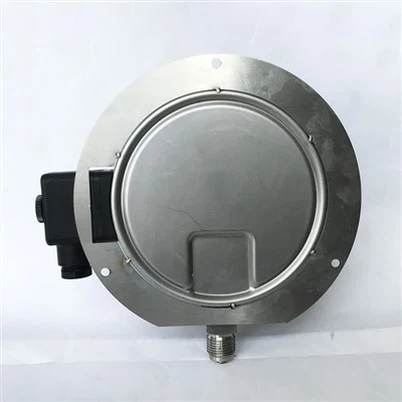
After understanding the importance of exhaust, it is also critical to master the timing and method of exhaust. It is generally recommended to vent the pressure gauge before it is installed on the system and is ready for use. The specific operation of venting is usually simple: most ventable liquid-filled pressure gauges will have a specially designed vent valve or vent plug on the top or side. This might be a small cap that twists or pulls up, or a screw plug that needs to be loosened slightly with a tool, such as a screwdriver. During operation, just follow the instructions in the manual and gently open the exhaust device to allow the inside of the watch case to communicate with the atmosphere. At this time, if there is internal pressure, the gas will be discharged with a hiss; if there is negative pressure, a small amount of air will be sucked in. The key is to balance internal and external pressures. After exhausting is completed, be sure to reset the exhaust valve or exhaust plug to a closed or sealed state to prevent subsequent dust, moisture from entering, or filling fluid from overflowing at certain installation angles.