Why Does Pressure Gauge Positioning Affect Measurement Accuracy?
Leave a message
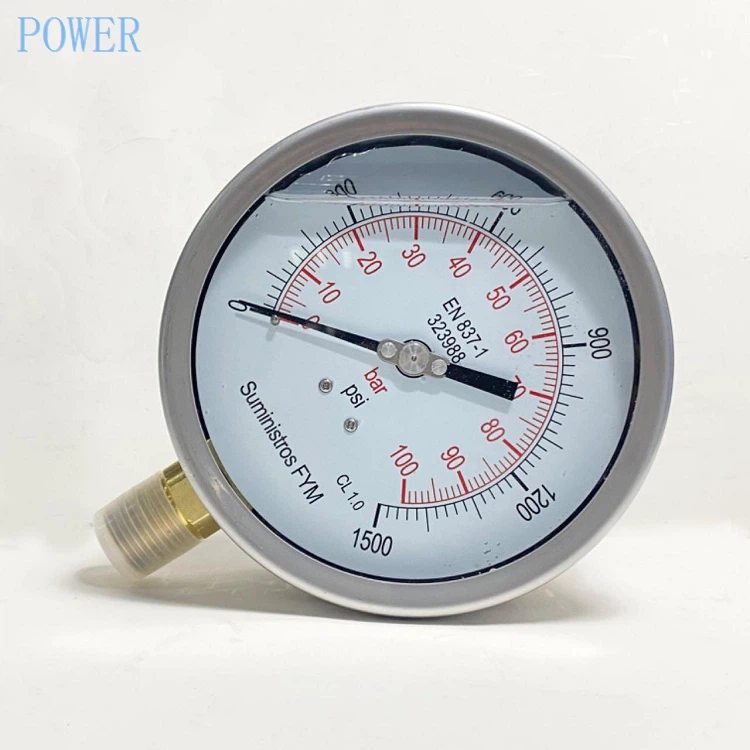
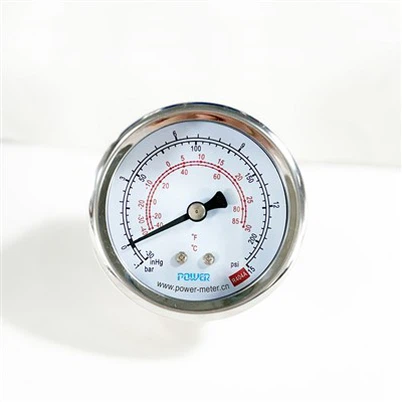
Pressure gauge, as one of the most common measuring instruments in industrial production and scientific research, its core task is to accurately reflect the pressure value of the measured medium. However, when using a pressure gauge, many users tend to only focus on its range and accuracy level, but ignore an equally critical factor - the installation location. Improper installation location may cause reading deviations and even cause safety accidents. Therefore, this article will discuss its impact on the measurement accuracy and stability of the pressure gauge from the perspective of installation location, hoping to provide a reference for installation in practical applications.
Error caused by hydraulic pressure
When measuring the pressure of a liquid medium, the weight of the liquid itself creates pressure, which is the so-called hydrostatic head. Its size is proportional to the density of the liquid and the height of the liquid column. If there is a vertical height difference between the installation position of the pressure gauge and the actual pressure point to be measured (pressure taking point), then the liquid column formed by this height difference will have an additional impact on the reading of the pressure gauge.
Specifically, when the pressure gauge is installed lower than the pressure point, the meter reading will be higher than the actual pressure at the pressure point, and the higher part is equal to the static pressure generated by the liquid column between the two points; conversely, when the pressure gauge is installed higher than the pressure point, the meter reading will be lower than the actual pressure, and the lower part is also the static pressure of this liquid column. This error caused by the installation height difference is particularly significant when measuring low pressure or when high-precision readings are required. Therefore, when installing an instrument for measuring liquid pressure, the impact of the static pressure head must be considered and corrected, or the instrument and the pressure-taking point must be kept on the same level as possible.
Pressure gauges are generally designed to measure the static pressure of a fluid, which is the inherent pressure of the fluid independent of its flow rate. However, when a fluid flows in a pipe or container, its kinetic energy is converted into a portion of pressure, known as dynamic pressure. According to Bernoulli's principle, where the flow velocity is faster, the static pressure is relatively lower. If the pressure port of the pressure gauge is facing the direction of the fluid, or it is installed in an area with high flow rate (such as where the pipe cross section suddenly becomes smaller, inside an elbow, etc.), then what the meter measures will be the total pressure (static pressure + dynamic pressure) or a pressure value significantly affected by the flow rate, rather than the true static pressure.
In addition, elbows, valves, pump outlets and other locations in the pipeline are prone to turbulence and vortex. These unstable flow conditions will cause the pressure at the pressure point to fluctuate and change locally, causing the pressure gauge reading to be unstable or deviate from the average static pressure in the pipeline. Therefore, in order to accurately measure static pressure, the pressure tapping port should be set as far as possible on a straight pipe section with stable flow and low flow velocity, and the direction of the pressure tapping port should be perpendicular to the direction of fluid flow.
Thermal Expansion And Contraction
The impact of temperature changes on pressure measurement accuracy is reflected in two aspects. First, changes in ambient or medium temperature will directly affect the pressure gauge itself. The materials of the pressure gauge's elastic sensitive components (such as Bourdon tubes and diaphragms) and its transmission amplification mechanism will undergo thermal expansion and contraction due to temperature changes, thereby changing their elastic properties and geometric dimensions, causing the indication value to drift. Although modern pressure gauges use temperature compensation designs, this effect cannot be ignored in environments with extreme temperatures or severe temperature fluctuations.
Secondly, temperature changes of the measured medium will cause changes in its density, especially for liquid media. Changes in density directly affect the size of the liquid static head mentioned earlier. Even if the installation height difference is fixed, changes in medium temperature will lead to changes in the static head error. At the same time, temperature will also affect the viscosity of the medium, which may affect the flow state near the pressure port. Therefore, the pressure gauge should be installed in a place with a relatively stable temperature as much as possible, avoid direct sunlight, close to heat or cold sources, and take heat insulation or heat dissipation measures when necessary. When the medium temperature is too high or too low, accessories such as condenser tubes, isolators or radiators need to be installed to protect the instrument and reduce the direct impact of temperature on the measurement.


Vibration Distorts Readings
Industrial sites are often accompanied by the operation of machinery and equipment, which inevitably produces mechanical vibrations. If the pressure gauge is installed on equipment or pipes with large vibrations, the continuous vibration will cause the pointer, gear transmission mechanism and other components inside the gauge to vibrate, causing reading difficulties and increased visual errors. What's more serious is that strong vibration may accelerate the wear of the internal parts of the instrument and even cause damage, resulting in reduced accuracy or complete failure. In addition to mechanical vibration, the pressure pulsation of the measured medium itself (that is, rapid, periodic fluctuations in pressure, commonly seen in pumps, compressor outlets, or reciprocating equipment pipelines) can also cause trouble in measurement. Pulsating pressure will cause the pressure gauge pointer to swing violently, making it impossible to read a stable pressure value. It will also cause fatigue damage to the elastic components and transmission mechanism of the instrument, shortening its service life.
To overcome these effects, the pressure gauge should be installed away from the source of vibration. If this cannot be avoided, vibration reduction measures should be taken, such as using rubber pads or shock absorbing brackets. For pressure pulsation situations, a buffer or damper should be installed in front of the pressure gauge to smooth pressure fluctuations, protect the instrument and obtain relatively stable readings.
Pressure Port Selection
The smoothness of the pressure port is the prerequisite for ensuring accurate pressure transmission. If the pressure port is improperly selected, such as being set at the bottom of the pipeline or in a dead corner area of fluid flow, it can easily be blocked by sediment, dirt, crystals or viscous media in the pipeline. Once the pressure port or its connecting conduit is clogged, the pressure cannot be effectively transmitted to the pressure gauge, causing the gauge to have low readings, slow response or even no change at all, thus giving false pressure indications that may conceal the true process conditions or safety risks. Even if it is not completely blocked, the accumulation of sediment will narrow the effective pressure-taking channel and increase the resistance to pressure transmission, especially when the pressure changes rapidly, resulting in measurement lag and distortion. Therefore, the location of the pressure tapping port should be selected in a place that can represent the mainstream pressure of the measured medium and is not prone to accumulation of impurities. For media prone to precipitation or crystallization, the pressure port and pressure guide pipe should be inspected, purged and cleaned regularly. If necessary, a pressure gauge or pressure device with an isolation diaphragm or self-cleaning function can be used.