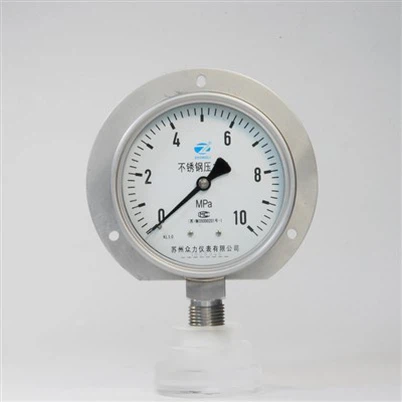
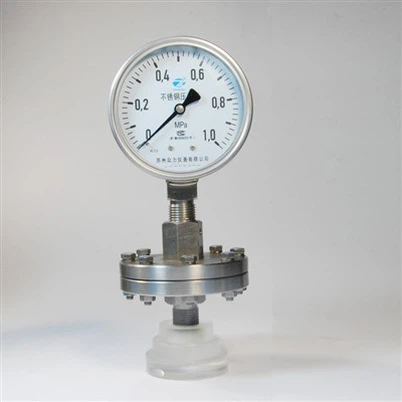
What Is the Recommended Operating Range for Standard Pressure Gauges?
Leave a message

In industrial sites, pressure gauges are one of the most important instruments in detection and control systems, and their reliability directly affects production safety and equipment operating status. However, many users are not familiar with the concept of "recommended operating range" and even mistakenly believe that they can be used as long as they are within the nominal range. In fact, the reasonable operating range is not only related to whether there is overpressure, but also to many key performance indicators such as measurement accuracy and structural life. It is an optimal usage range determined after comprehensive consideration of multiple factors. Therefore, this article will systematically elaborate on the definition of "recommended operating range", the basis of structural principles and its impact on service life and measurement accuracy to help readers use pressure gauges rationally.
The so-called "recommended operating range" refers to the pressure range in which the pressure gauge is most suitable for long-term operation in actual work. It is not the maximum pressure bearing capacity of the instrument itself, but a narrower range of use. This interval is usually located in the middle of the full-scale range, generally between 25% and 75% of the full-scale range.
This range is proposed based on the working characteristics of the internal sensitive components of the pressure gauge (such as Bourdon tubes, diaphragms, etc.): If the pressure is too small, the component will not deform enough and the reading will be unstable; if the pressure is too high, the component will be close to the limit deformation and prone to permanent damage. When within the recommended operating range, the elastic element is neither overstressed nor deformed enough to cause a decrease in sensitivity, so it can achieve the best balance between measurement accuracy and rebound performance.
Why should the pressure gauge operate in the middle range of the range?
Why is it important to run the pressure gauge in the middle of the range? This is closely related to the internal structure of the pressure gauge. Taking the most common Bourdon tube pressure gauge as an example, its C-shaped or spiral Bourdon tube will deform slightly (tend to straighten) when under pressure. This amount of deformation is directly related to the amount of pressure, and a small linear displacement is amplified into an angular displacement of the pointer through a transmission mechanism composed of connecting rods, sector gears, and center gears.
In the middle section of the measuring range, there is a linear correspondence between the deformation of the Bourdon tube and the pressure it bears, which means that pressure changes can most accurately be converted into synchronous rotation of the pointer, ensuring measurement accuracy. More importantly, working in the middle area, the stress endured by the Bourdon tube is much lower than its elastic limit and fatigue limit, which avoids material fatigue and elastic performance degradation (increased creep and hysteresis effects) caused by long-term close to the ultimate load, thus greatly extending the working life of the instrument.
Let the pressure gauge work near the beginning of the scale for a long time. It seems that the pressure load is light, but in fact it hides problems. At very low pressures, the deformation produced by the Bourdon tube is extremely weak and may not be sufficient to completely overcome the static friction inherent in the drive chain (i.e., "starting friction" or "stiction"). This can lead to a sluggish pointer response, that is, the pointer may not move or "jump" forward despite a small change in pressure, resulting in inaccurate readings and an inability to capture critical low-pressure dynamics. At the same time, for watches that are not designed for vacuum environments, if the pressure accidentally drops to negative pressure, the Bourdon tube may be stressed in the reverse direction, or external pollutants may be inhaled, causing damage to it.


Setting the working pressure to a high-pressure area close to the full scale can easily cause the system to instantly overpressure. In industrial processes, operations such as valve switching and pump starting and stopping can easily produce instantaneous peaks (pressure pulses or water hammer) that far exceed normal operating pressure. If the instrument is usually running at a high level, it will not be able to absorb more impact when overpressure occurs, which can easily lead to permanent plastic deformation of the Bourdon tube (unable to return to zero), or even direct expansion and bursting, causing high-pressure medium injection and causing serious safety accidents.
To take a step back, even if severe overpressure does not occur, subjecting the Bourdon tube to pressure close to its design limit for a long time will accelerate the fatigue process of its metal materials. Just like a metal wire that is repeatedly bent will eventually break, the Bourdon tube is repeatedly deformed under high stress, and micro-cracks will gradually develop and expand inside, leading to a decrease in elasticity, zero-point drift, excessive indication errors, and ultimately early scrapping. At the same time, the transmission mechanism operates under high load, and the wear of gears and bearings will also increase. Therefore, keeping away from full scale is a hard requirement to protect the instrument.
How to choose a pressure gauge with the appropriate range?
Choosing an appropriate pressure gauge is much more than just making the working pressure point fall within a certain percentage range of the range. This is a process that requires careful consideration of the dynamics of working conditions. First of all, it is necessary to accurately evaluate the "normal working pressure", which not only refers to the pressure value during stable operation, but also includes the pressure that may occur when the system starts, stops, or switches between different working conditions. Secondly, the "maximum possible pressure" must be fully estimated, including foreseeable peak pressures (such as the maximum fluctuation before the safety valve set pressure) and potential abnormal instantaneous pressures.
The principle of selection is to ensure that the normal working pressure is within the recommended range (usually the middle section of the range, such as 1/3 to 2/3). At the same time, the maximum estimated pressure (including instantaneous peak value) should not exceed the specific upper limit of the range (for example, for a pressure gauge working under stable pressure, no more than 75% of the range; for a pressure gauge working under fluctuating or pulsating pressure, it may need to be more conservative, such as no more than 2/3 of the range), and the maximum allowable overload pressure of the instrument must not be exceeded. This not only ensures the accuracy of daily measurement of the pressure gauge, but also leaves sufficient safety buffer for abnormal situations.