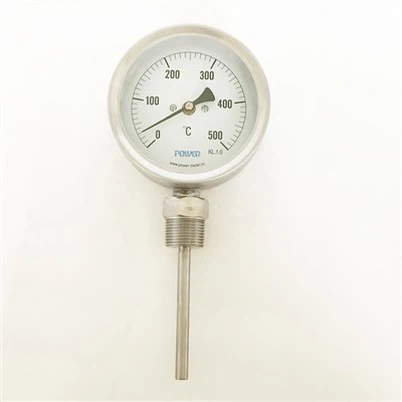
How to Read a Bimetallic Thermometer Correctly?
Leave a message

Bimetal thermometer is a common mechanical temperature measurement tool, widely used in industrial production, laboratories and other fields. It has a sturdy structure, requires no power supply, and has intuitive readings. However, if used and read improperly, it may lead to incorrect temperature judgments, thereby affecting production safety or experimental accuracy. This article will systematically explain how to correctly read a bimetal thermometer from principle analysis, preparation for use, reading techniques to common misunderstandings.
The measuring component of a bimetal thermometer is a metal strip composed of two metal materials with different expansion coefficients. This metal band is usually rolled into a spiral or coil spring and installed inside the thermometer. When the temperature changes, the entire metal strip will bend or rotate due to the different degrees of thermal expansion and contraction of the two metals. This mechanical deformation will drive the pointer on the dial to deflect through the transmission mechanism, thereby displaying the current temperature value. The advantage of this kind of component is that it is sturdy and durable, but because its response speed is slightly slow and affected by the precision of the mechanical structure, it is easy to misread it if you do not understand how it works. Therefore, understanding the logic of "thermal expansion and contraction-deformation-pointer movement" before reading is the prerequisite for correctly reading the temperature.
The temperature-sensing part of a bimetal thermometer is usually a metal probe that needs to be inserted into the medium being measured. Many people mistakenly believe that as long as the thermometer is inserted, it will be able to read, but in fact, the measured temperature is representative only when the probe is inserted deep enough and fully contacts the medium being measured. If the insertion is too shallow, or the probe just hits the container wall, heater, cold spot, etc., data distortion will occur due to local temperature differences. Therefore, the standard operating requirement is that in liquid or gas media, it is necessary to ensure that the temperature-sensing section of the metal probe-that is, the area with the bimetallic spiral or the area where the heat-sensing element is located-is completely immersed in the medium for at least two-thirds of its length and avoid container walls, heaters, cooling areas, etc.

Avoid misjudgments due to inertial errors
Bimetal thermometers rely on mechanical deformation caused by thermal expansion and contraction of the metal to drive the pointer, rather than instantaneously reflecting the temperature through electrical signals like electronic thermometers. Therefore, its response process is not instantaneous, but a slow dynamic process. This delay is mainly due to two factors: first, the heat conduction process of the metal itself takes time, and second, the internal mechanical transmission structure (such as spiral bimetal belt, gear, rotating shaft) has a certain inertia and mechanical resistance.
In an environment where temperature changes suddenly occur, a "hysteresis" will occur when the metal changes from the original state to the target state, that is, the temperature change has occurred, but the pointer is still gradually adjusting. For example, when a thermometer is taken out of a normal temperature environment and inserted into a pot of boiling water or high-temperature steam, the outer layer of the temperature probe first begins to heat up, and it takes a while for the temperature of the inner metal and the entire structure to be evenly conducted and stabilized. During this process, the initial reaction of the pointer is often a rapid rise, but after reaching the approximate temperature, there will still be a slow deviation process due to the incomplete internal heat distribution. This slight shift may last for tens of seconds.
If you read hastily during this "pointer has not yet stabilized" stage, you may mistakenly regard the transition process as the final temperature. For example, when the temperature has not yet been completely transferred to the internal metal, the reading value will be low; and if the floating pointer caused by residual heat is read immediately after the high temperature source is removed, the current temperature may be overestimated. Therefore, the standard usage method should be to keep the probe still after the thermometer is placed in the environment to be measured, at least wait for the pointer to completely stop and maintain stability for a few seconds, and then take a visual reading.

Many users stand on one side and look at the thermometer diagonally when reading, but they do not know that this will cause reading errors due to the "parallax" phenomenon. The so-called parallax (Parallax Error) is due to the fact that the observer's line of sight is not perpendicular to the axis of the pointer and the scale surface of the dial, resulting in the visual illusion of "the pointer shifts between different scales" in three-dimensional space. In other words, even if the pointer is not moving, observers from different angles will see different readings.
To avoid this phenomenon, standard practice requires that the observer should aim his eyes at the center of the thermometer dial when reading, that is, the line of sight should intersect perpendicularly with the axis of the pointer and the dial. At this time, the position where the pointer coincides with the background scale is its true position. In order to help users determine whether they are at the correct viewing angle, some thermometers add a mirror scale ring on the glass surface. When the line of sight is vertical, the pointer body and its reflection in the mirror coincide with each other; if the viewing angle is offset, the pointer and the mirror image will be misaligned, thus prompting the user that the angle is wrong.
Correctly understand the relationship between scales and pointers
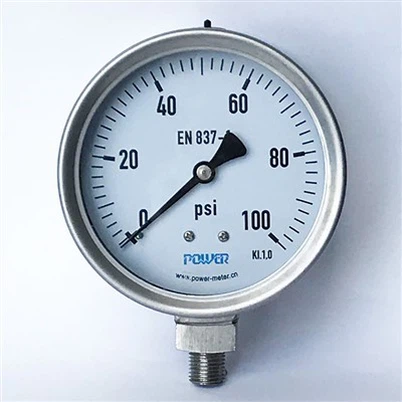
The dial of a bimetal thermometer generally has a thick main scale (for example, each division represents 10°C), and a fine secondary scale (for example, each division represents 1°C or 2°C). Some users do not know how to judge when the pointer falls between two scales, or they make random estimates, resulting in inaccurate readings. The correct approach is to understand the units of the scale and make a reasonable estimate based on the position of the pointer. For example, if the pointer is slightly closer to 50°C between 40°C and 50°C, it can be judged to be about 46°C. If the pointer falls exactly on a certain scale line, read the scale value directly.